Walk into just about any café today and you'll find it everywhere: matcha lattes, matcha muffins, matcha croissants. What began as a centuries-old Japanese ritual has become a global ingredient. But matcha is far from the same everywhere, and those differences matter, both in flavor and in use.
At KYŌ-KLUB we work exclusively with ceremonial grade matcha from the tea fields of Uji, Japan. Here's what sets it apart from its culinary counterpart, and why that difference shapes everything that ends up in your cup.
What is ceremonial grade matcha?
Ceremonial grade sits at the very top of the quality ladder. It's stone-ground from the youngest, first-harvest leaves of shaded Camellia sinensis. Before grinding, those leaves are called tencha, and they're carefully stripped of stems and veins and dried, before being slowly ground between granite stones into a fine, silky powder.
Because only the top leaves are picked, and because the plants spend three to four weeks under shade before harvest, the leaves build up a remarkable concentration of chlorophyll and L-theanine. The result is a vivid, almost luminous green powder that's naturally sweet and umami-rich, with almost no bitterness.
This grade is made to be whisked with nothing but hot water, no milk and no sweetener. In the Japanese tea ceremony that preparation is called usucha, or thin tea. The flavor is layered enough to carry a cup entirely on its own.
What is culinary grade matcha?
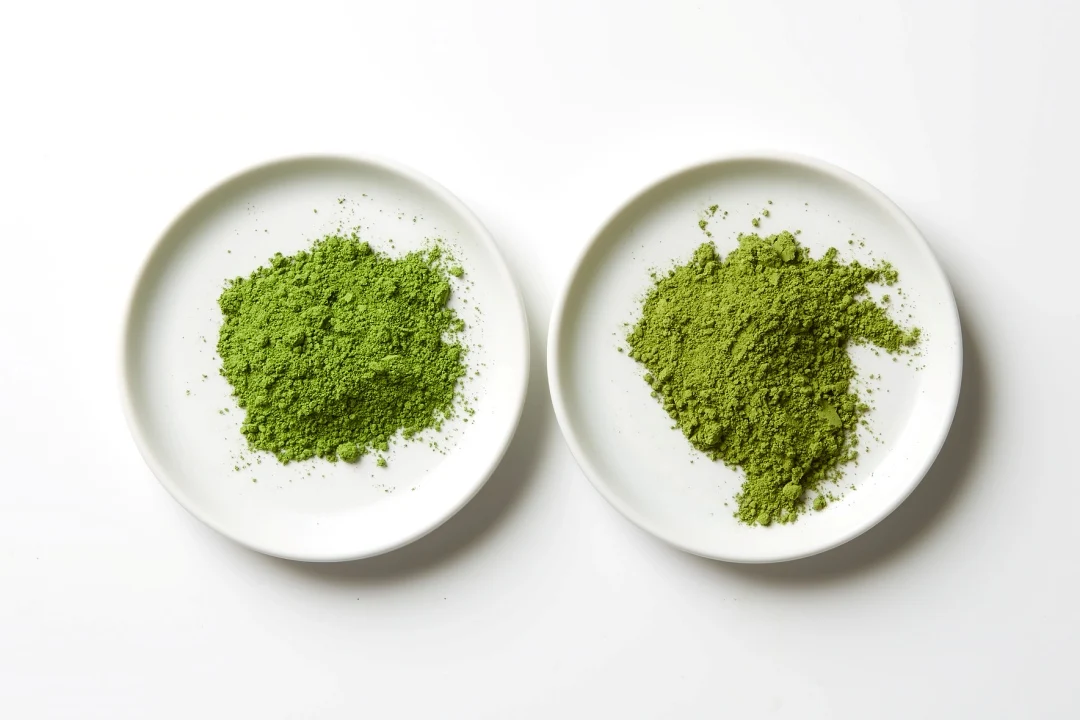
Culinary grade comes from older, more mature leaves picked later in the season, often from plants that were never shaded. Those leaves contain more tannins and catechins, which makes the flavor sharper and more astringent. The powder is coarser, less vivid in color, and noticeably more bitter.
That bitterness isn't automatically a flaw. In baking, cooking, and mixed drinks, culinary matcha's bitter edge cuts nicely through the sweetness of sugar, cream, or milk. A matcha latte, a matcha cake, a scoop of matcha ice cream: culinary grade shines here because its pronounced flavor holds up alongside other strong ingredients.
It also comes at a lower price, which makes sense for recipes that genuinely call for volume.
The flavor difference
Tasted side by side, the contrast is striking.
Ceremonial grade opens with a grassy, almost vegetal sweetness on the nose and follows with deep umami across the palate. A natural sweetness lingers long after the last sip, with no bitterness and no rough edges. The color is a saturated, radiant green.
Culinary grade is duller, both in the cup and on the tongue. The bitterness announces itself immediately, the finish is drier, and there's far less of the layered complexity ceremonial offers. Functional, but not something to sit with.
Which one should you use?
That depends entirely on what you're making.
Whisking it with water? Always ceremonial grade. You're drinking the matcha unmasked, so the quality defines the entire experience. Pour hot water at around 70 to 80°C, whisk in a W or M motion with a bamboo chasen, and drink it right away.
Cooking or baking? Culinary grade fits perfectly. Muffins, cookies, ice cream, sauces, smoothies: the heat and mixing reshape the flavor anyway, and culinary matcha's stronger taste works in your favor here.
A matcha latte? This sits in between. Many cafés reach for culinary grade because the milk masks the bitterness. At KYŌ-KLUB we use ceremonial grade across the board, lattes included, because we find the quality still comes through with milk, and because it simply makes for a better drink.
A word on price
Ceremonial grade does cost more than culinary, and that premium is real. Stone-grinding is slow work, the harvest window is narrow, and shading demands significant labor and attention. A batch of good ceremonial matcha can take 30 to 60 minutes to grind per 30 grams.
If matcha is cheap, you're almost certainly looking at culinary grade or an even lower quality sold as ceremonial. Expect a duller color, a more bitter taste, and health benefits that are less concentrated.
What we pour at KYŌ-KLUB
Every product on our shelves and every drink we make in our Amsterdam café is ceremonial grade matcha from Uji. Season after season we buy directly from the same small producers, and we only offer what we've tasted ourselves and stand behind.
If culinary grade is all you've ever tried, that first sip of good ceremonial matcha usually lands as a real revelation. The sweetness catches you off guard. The color is extraordinary. The finish settles exactly where you'd want it to.
That's the version of matcha we want everyone to meet. It's the version that makes the whole ritual worth it.